
Live Topology
A diagram you can learn by heart is one that has stopped tracking reality. Your system's shape reflows as the system moves, because it is drawn from what is actually running. You do not memorize the map. You read it.
Start FreeEvery architecture diagram in your wiki is a drawing of a system that no longer exists. It was accurate the week someone drew it. Services came and went, a team split one in two, something got retired and nobody redrew the box. The diagram did not go wrong all at once. It went wrong quietly, while staying legible, which is the dangerous way to be wrong. IAPM does not draw your system. It renders what is running.
- The layout is not fixed, and that is the point. A pinned board is stable precisely because it froze. Services come and go, the shape reflows, and the space you walk into today is the system as it is today, not as it was when someone last had time to update the picture.
What persists is not a coordinate, but a relationship
A service can sit anywhere; its callers and dependencies are always the neighborhood around it
The neighborhood is the address
Do not expect to memorize it. You are not supposed to.
- Position is drawn, not assigned: nobody laid your system out by hand. The shape comes from what is calling what, right now, so it tracks reality instead of tracking whoever last edited the diagram.
- Relationships survive the reflow: the payments service may sit anywhere on screen. Its callers and dependencies are always around it, so you find things by standing near them, not by remembering where they were.
- Arrive and it is already scoped: standing at a node puts its neighborhood in frame. No filter written, no filter babysat mid-incident.

A diagram you can learn by heart is one that has stopped tracking reality
The board on the wall is stable because it froze, and it is quietly wrong the moment the system moves on
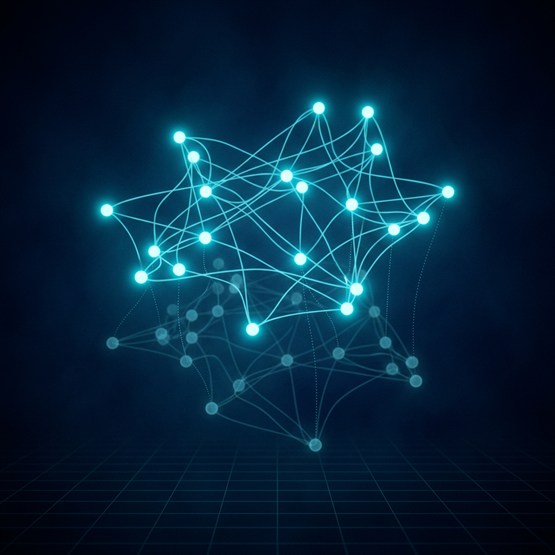
Where the gap becomes legible
This is what a moving map buys you that a frozen one cannot.
- The hole has a place: a service that should be calling this one and today is not shows up as a gap in the cluster it belonged to, wherever the layout put that cluster.
- Found by the living: you do not hunt the missing peer by memory. The ones still alive are standing around the hole. See what isn't there.
- Drift is data: a shape that reflows tells you the system changed. A picture that never moves tells you nothing, twice.
The moving map has a price, and we are not going to pretend otherwise
A shape you must re-read, against one you have memorized but cannot trust
What it costs you
- You pay a re-orientation cost every time you look. Because the layout reflows, you cannot build the muscle memory of a room that never changes. You read the current shape instead of reaching by reflex, and you pay it per environment, since staging and prod need not settle the same way.
- The bet is that this is worth it: a shape you must re-read but can trust beats one you have memorized but cannot. That bet is not free, and it is not yet proven. When we have the number, we will publish it either way.
- At real scale it has to earn itself: whether a topology of thousands stays legible instead of becoming its own noise is unproven. The intent is that you enter one neighborhood at a time.
Why we say this out loud: read the manifesto.
Always-On Demo
Running right now, unscripted, and nobody started it for you. It is a synthetic system rather than a customer's, but nothing about it is staged: we point chaos at it and hunt the gap live. Watch for a minute, send it to whoever is on call with you, or scroll on and go play with one yourself.
The Better Way to Monitor and Manage Your Software
Streamlined Setup
Simple integration
Cloud-native and open source friendly
Rapid Root Cause Analysis
Intuitive tooling
Find answers in a single glance. Know the health of your application
AI Powered
AI Assistant by your side
Unlock the power of AI for assistance and resolution
Intuitive Solutions
Conventional and Immersive
Expert tools for every user:
DevOps, SRE, Infra, Education