
Immersive Press Releases
Get latest news about us.
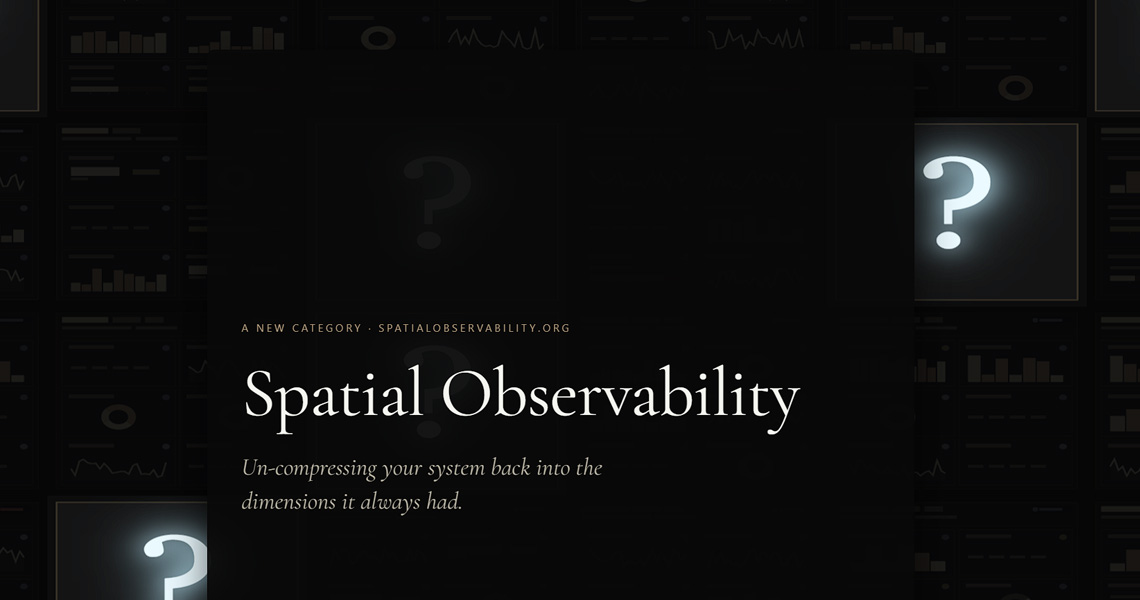
Immersive Fusion Names a New Category: Spatial Observability
A service graph is, literally, a graph. Requests have paths through it. Failure clusters, latency, and dependency pressure all have shape. Software has always had topology, and for fifteen years the dominant monitoring tools have flattened that topology into rows, charts, and panels refreshed every fifteen seconds. Immersive Fusion is giving the alternative a name: spatial observability, the practice of un-compressing high-dimensional system reality, its topology, request paths, failure neighborhoods, and latency distance, back into the dimensions it always had.
The full argument is set out in the company's manifesto, Refuse the Flatness. The short version: the dashboard was the first-generation compression of a multi-dimensional reality onto a flat surface, built when hardware, browsers, and bandwidth were scarce. Those constraints are gone. The hardware that runs modern video games sits on most engineers' desks. The screen can now render a system as the place it always was, and a flat grid of panels is no longer the best a tool can do.
The cost of staying flat is documented. New Relic's 2024 Observability Forecast found that engineering teams run four to five separate monitoring tools on average, and the time lost switching between them is a measurable drain on the hours spent keeping systems alive.
The Thing That Isn't on the Screen
The capability Immersive Fusion points to as category-defining is absence rendering: the ability to draw the thing that did not happen, in the place in the system where it belongs. The request that should have arrived and didn't. The service that should be answering and isn't. The queue that drained and never refilled.
A flat tool can fire an alert that a request failed to arrive. It cannot put the missing request on the map, next to the services it should have connected, on the path it should have taken. A spatial system can, because the instrumented services still calling a silent one already say what should be there. When an expected peer stops answering, it is not declared lost on the first missed beat, a deploy or an autoscale-down would trip that constantly. It is held unresolved, and only after it stays gone past a dwell threshold does it harden into a phantom: a black hole drawn among the live callers still reaching for it. If the peer comes back, the hole closes and the node returns to what it was. A phantom is a live inference that can resolve, not a verdict. And the contrast is what makes it legible: a real service that goes idle loses its color and is pruned away, simply gone, while the phantom stays dark among the living, because it was never traffic to begin with.
"A flat tool can fire an alert that a request failed to arrive," said Dan Kowalski of Immersive Fusion. "It cannot draw the gap where the request should have been. A spatial medium can. That difference is the whole reason this category needs a name."
The First Implementation: DeepCube
Immersive Fusion's product, DeepCube, is the first implementation of the category as the company defines it: an OpenTelemetry-native platform where a distributed system is navigated as 3D space and absence is rendered as a spatial fact, not an alert. Instead of correlating a wall of dashboards, an engineer walks the live system in 3D: services are objects, traffic is light moving between them, stress is heat, and a failing path is drawn where it failed. The approach is not visual novelty. The foundational principle of information visualization, that mapping abstract data onto spatial structure amplifies human cognition, has been established research since Card, Mackinlay, and Shneiderman's work in the 1990s; spatial observability applies it to a running distributed system. The navigable 3D environment inside DeepCube is the Spatial Observatory; spatial observability is the category it embodies. (One is the place; the other is the practice.)
Beside the engineer is Tessa, the product's AI assistant. Tessa reasons over the same telemetry the engineer is standing in: walk toward a failing service and Tessa's attention narrows to the same neighborhood. It proposes; the engineer decides. The company calls this posture human-on-the-loop, and treats it as a design principle rather than a limitation: the engineer is not the slow part of the system, but the part that lives with the consequences.
Already Running, Already Open
A category claim is only worth what you can run. Immersive Fusion's TraceGen, released earlier this year under Apache-2.0, was built to feed DeepCube and works with any OTLP backend, not only its own. From a single binary it generates a 28-service platform across 59 pods and 40 scenario flows, traditional microservice and AI-agent traces alike. It can manufacture absence directly: run it with dead consumers and producers keep emitting to queues no one drains, so work piles up that never gets picked up, the request that should have arrived and didn't. Point a flat tool at that stream and a spatial one at the same stream, and the difference the category is named for becomes something an engineer can see for themselves rather than take on faith.
Immersive Fusion accepts the OpenTelemetry standards gratefully and refuses to extend them with proprietary agents a customer cannot escape. The data is the customer's. Leaving means changing one endpoint.
Built in the Open
Immersive Fusion is building the category in the open. TraceGen and an OpenTelemetry MCP server, which exposes live telemetry to AI coding assistants over the Model Context Protocol, are public and Apache-2.0; the manifesto is public; DeepCube ships with a free tier, in the browser, on the desktop, and on Steam for the engineers who want the deepest immersion; and the live grids stream on Twitch when the team is broadcasting, for anyone who wants to watch rather than install. The company's position on AI is that immersion and Tessa are complements to the engineer, not substitutes, and it says plainly that the category will be judged on a number it intends to publish: whether engineers actually find problems faster, with less context-switching, than they do against a good dashboard today.
"We built on the open standards instead of around them," said John Coons, Immersive Fusion's Director of Alliances and Special Projects. "TraceGen speaks plain OpenTelemetry and feeds any backend, including the ones we compete with, because a category this size is too important to be owned by one vendor. We would rather help define spatial observability in the open for everyone to use than to fence it off."
Read the manifesto Run TraceGen Get the immersive client Watch live on Twitch

Dan Kowalski
Father, technology aficionado, gamer, Gridmaster
About Immersive Fusion
Immersive Fusion (immersivefusion.com) is pioneering the next generation of observability by merging spatial computing and AI to make complex systems intuitive, interactive, and intelligent. As the creators of DeepCube, we deliver solutions that combine web, 3D, and AI technologies, empowering teams to visualize and troubleshoot their applications in entirely new ways. This approach enables rapid root-cause analysis, reduces downtime, and drives higher productivity, transforming observability from static dashboards into an immersive, intelligent experience. Learn more about or join Immersive Fusion on LinkedIn, Mastodon, Bluesky, X, YouTube, Facebook, Instagram, GitHub, Twitch, Discord.Press inquiries: press@immersivefusion.com.
The Better Way to Monitor and Manage Your Software
Streamlined Setup
Simple integration
Cloud-native and open source friendly
Rapid Root Cause Analysis
Intuitive tooling
Find answers in a single glance. Know the health of your application
AI Powered
AI Assistant by your side
Unlock the power of AI for assistance and resolution
Intuitive Solutions
Conventional and Immersive
Expert tools for every user:
DevOps, SRE, Infra, Education